Personnel Development
Mediation & Conflict Management
Mediation supplements conventional forms of conflict resolution with a particularly effective procedure that helps the parties to the dispute to resolve or avoid conflicts on their own responsibility and in a mutually beneficial manner.
Personnel Development
When things get heated or heavy: Three offers for dealing with conflict
Is a conflict breaking out and you fear for the working atmosphere or the health of your employees? Smoldering disagreements, but no one knows the details? Uncertain managers who have to handle complaints?
Unresolved conflicts and open disputes cost time, nerves, and unfortunately, employees. To prevent it from getting that far, we support you and your employees in situations before, during, or after the conflict.
Unsure what will help? Contact us.

Mediation
Stress from disputes among colleagues or in collaboration? We mediate conflicts in the working and business world – with Diversity Mediation, sichtbar systemisch.
Collaboration and a Culture of Learning from Mistakes
Does your team need to reinvent itself, utilize diversity, or secure knowledge? Within a confidential framework, we provide support with factual issues and the management of dynamics.
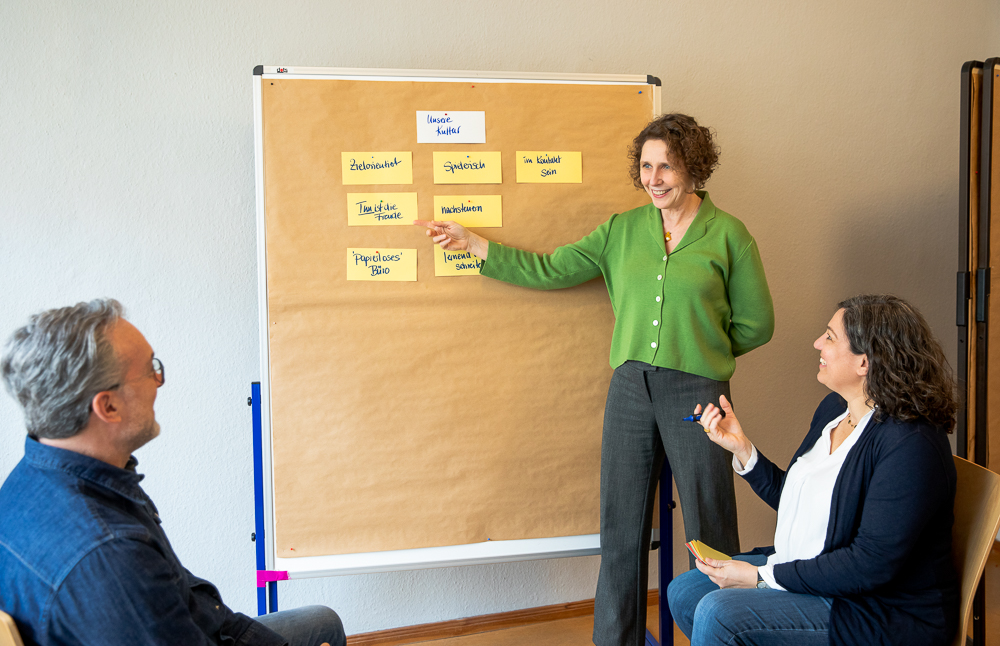
Introduction to conflict management
In two days, you will gain an overview of conflict management methods, their opportunities, and limits. You pick the best elements from mediation and practice how to use them.
AGAINST FRICTIONAL LOSSES
We mediate your conflict
Are employees reporting stress from conflict? Are teams or organizational units working against each other – and you want to minimize friction losses? Whether before, during, or after the conflict: those involved develop their own solutions in a protected setting. Mediation helps to reach a settlement quickly and confidentially, without closing off the future, while maintaining control over events.
Mediation (Vermittlung) is a process for settling conflicts and disputes out of court together and by mutual agreement. In the process, those involved experience or develop appreciation and respect for one another and their (professional) environment. On this basis, they find agreements that are beneficial for everyone and shape the near future.
Whenever possible, we work in pairs. It has proven sustainable to make the systemic approach sichtbar systemisch. This allows us to consistently offer a second level of observation, reflection, and processing. The mediators lead through the phases, do not judge, and do not decide. You, as the participants, act on your own responsibility.
Diversity Mediation acknowledges the stress of disputes, values conflict competence, and respects diversity as normality. It reduces complexity at the appropriate point and opens up spaces where people meet as individuals – the foundation for shared, sustainable solutions among colleagues, in business relationships, and with superiors.
Interested? Then contact us:
FAQ
Questions about mediation
How does mediation help?
… offer a fast and cost-effective solution.
… help you avoid closing off the future with your conflict partner.
… Guarantee confidentiality.
… Ensure control over events.
… offer new, surprising solutions that you design yourself.
What is mediation?
Mediation translates as “conciliation”. The term describes a process by which conflicts and disputes are resolved outside of court.
The parties to the conflict find an amicable settlement that is beneficial to them and shapes the near future. At the same time, the self-determination, esteem and dignity of those involved is preserved.
This elaborated regulation is recorded in an agreement.
Mediation at our company always includes the aspects of human diversity, balance of power and appreciation.
In which areas can mediation be applied?
The world of family
In disputes between parents and children, siblings, heirs.
The everyday world
In disputes in and around living space and the living environment, in the neighborhood, in intercultural conflict, during construction.
The business and working world
In business relationships, in disputes among colleagues, with superiors.
The school world
Disputes among colleagues, with or between parents, students.
Public space
In and with administration, politics, or regarding environmental projects.
So that you can find a settlement together that is beneficial for all involved and remains sustainable in the future.
How does a mediation process work?
Whenever possible, we work in pairs. It has proven sustainable for mediation to make the systemic approach visible. This allows us to consistently offer you a second level of observation, reflection, and processing. Solutions become possible more quickly.
As participants, you act and decide on your own responsibility from beginning to end. The mediators lead through the phases, do not judge, and do not decide. We support you as participants in developing your own solutions.
The five phases provide you with a supportive framework:
Preparation
The participants agree on the costs, duration, and those to be involved, and conclude the mediation contract.
Collection
The participants name the areas of conflict and topics they want to address and prioritize them. They gather the necessary information.
Deepening
You present your point of view and name interests, ideas, values, motives, or the significance of your position. You arrive at new possible solutions.
Negotiation
The participants each make offers to their counterpart. In this way, they develop preliminary solutions. They evaluate these with regard to their practicality and economic efficiency.
Agreement
The participants review the solutions. They conclude a legally binding agreement.
The mediators monitor compliance with the five principles throughout the entire process:
Voluntariness
You determine the course of events. You can end the process at any time.
Neutrality
The mediator is neutral, or rather, all-partial. This is the foundation of their work.
Self-responsibility
You, the participants, know your situation best. You take responsibility for it.
Informedness
You, the participants, know what is at stake and the framework within which you are operating. Should you or the mediator determine that you have information gaps, you will be given the opportunity to inform yourselves.
Confidentiality
All participants provide a written assurance to maintain confidentiality.
The length of a mediation process depends on the complexity of the conflict and the number of people involved. The range extends from a single session of 2 to 8 hours to several sessions, depending on the agreement.
FAQ on the approach
Questions about Diversity Mediation
What is diversity mediation?
Diversity mediation is a method of conflict resolution that is inspired by intercultural competence and works in a diversity-sensitive way. This makes it very broad-based and effective.
What does “Diversity” mean in this context? The various forms of human diversity can be the cause of a dispute or become a topic in the conflict (without necessarily having triggered it). The lines of conflict can then open up, for example, between men and women, young and old, queer and cis, East and West, rich and poor, and more. The various forms of human diversity also include the very individual experiences and life worlds of persons and incorporate this background into the mediation.
In classic mediation training, intercultural conflicts are treated as a special issue and problem. DiversityMediation, on the other hand, utilizes the diverse potentials of the conflicting parties. DiversityMediation thus sees in variety not only possible causes and topics of dispute, but also diverse backgrounds for solution approaches. Diversity is therefore not automatically assumed to be the cause of conflict in DiversityMediation, but experience shows that conflicting parties in a dispute focus almost reflexively on differences, so that these can be a flashpoint. However, experience also shows that differences produce diverse solution possibilities.
In DiversityMediation, the mediator and the conflicting parties work out at an appropriate time what meaning equality or inequality really has for the parties, the dispute, and the solutions.
What does Diversity Mediation make visible?
At this point, the question of power distribution can become visible. And what is visible can be discussed, understood and comprehended.
At intaqt, we believe that those who have practiced using the visible aspects of diversity to address different experiences are also sensitive to the different worlds of invisible, unspoken differences. Diversity mediation therefore also provides training for supposedly “normal” conflicts in which the conflict parties appear to be the same.
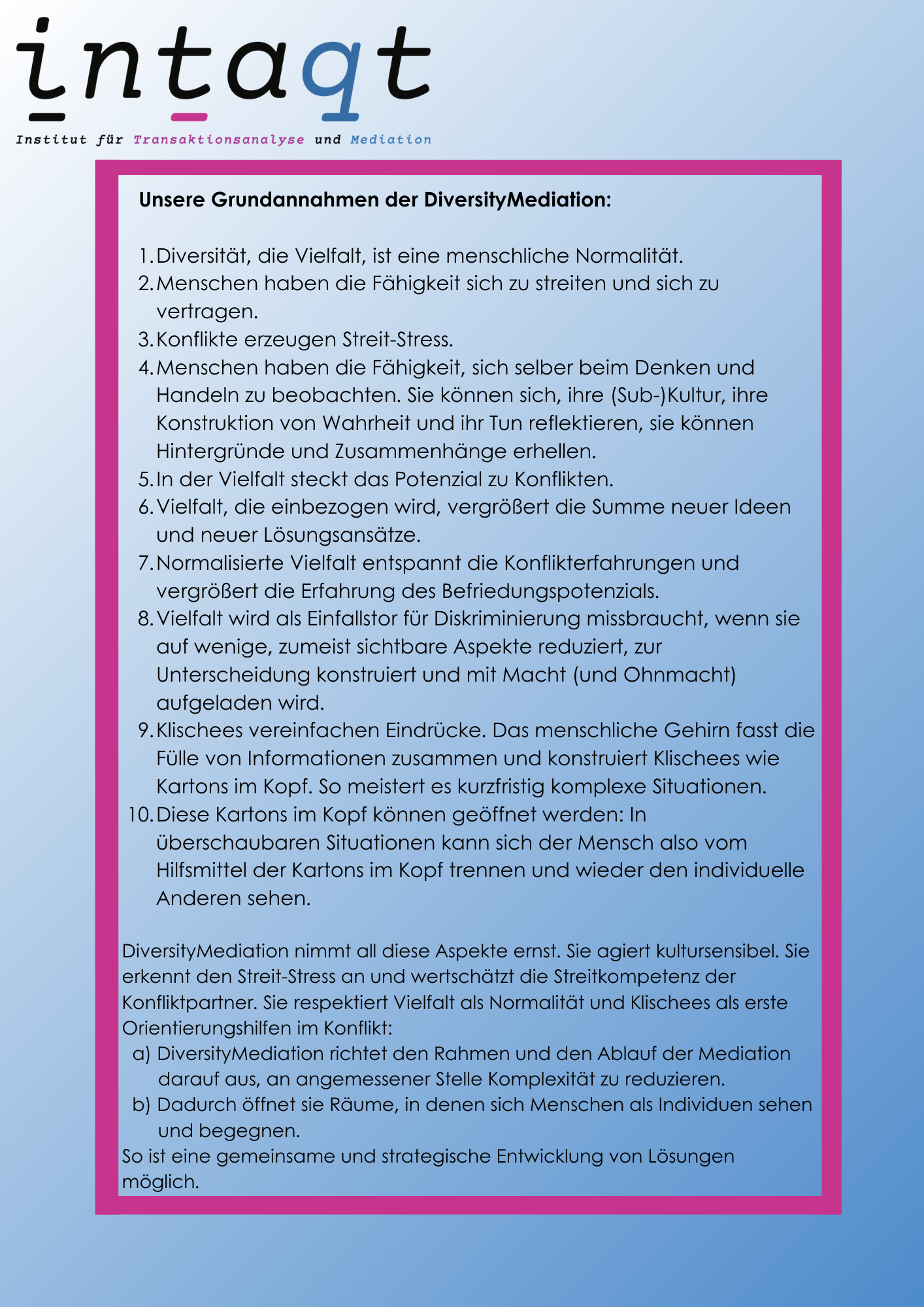
What are the basic assumptions of Diversity Mediation?
- Diversity is a human normality.
- People have the ability to argue and to get along.
- Conflicts create stress.
- People have the ability to observe themselves as they think and act. They can reflect on themselves, their (sub)culture, their construction of truth and their actions; they can shed light on backgrounds and contexts.
- Diversity harbors the potential for conflict.
- Diversity that is included increases the sum of new ideas and new approaches to solutions.
- Normalized diversity eases the experience of conflict and increases the experience of the potential for pacification.
- Diversity is misused as a gateway to discrimination when it is reduced to a few, mostly visible aspects, constructed to differentiate and charged with power (and powerlessness).
- Clichés simplify impressions. The human brain summarizes the wealth of information and constructs clichés like boxes in its head. This is how it masters complex situations in the short term.
- These boxes in the head can be opened: In manageable situations, people can separate themselves from the aid of the boxes in their heads and see the individual other again.
To what extent is Diversity Mediation culturally sensitive?
Diversity mediation takes all these aspects seriously. It is culturally sensitive. It recognizes the stress of the conflict and values the conflict partners’ ability to resolve disputes. It respects diversity as normality and clichés as the first point of reference in a conflict:
- DiversityMediation aligns the framework and process of mediation to reduce complexity where appropriate.
- This opens up spaces in which people see and encounter each other as individuals.
This enables the joint and strategic development of solutions.
What does Diversity Mediation look like in practice?
Mr. Meyer and Ms. Maier are arguing. My superiors call me into a situation in which a whole package of accusations and assumptions are already flying back and forth:
- He or she has no idea about the subject,
- and also reacts inappropriately in situations.
- He or she treats the team and colleagues completely wrong.
- She or he has nothing to say to me.
Dispute stress
We start the diversity mediation. Both of them soon escalate to the statements “typically male” and “typically female”. Both are firmly convinced that they cannot work together because the other person cannot get out of their role as “the man” and “the woman”.
I ask – what exactly is typical of “man” or “woman”, and get the following answers:
Mr. Meyer is a narrow-minded “salesman” who believes he has to subject everything to figures. A typical businessman and business administrator, according to Ms. Maier. So short on time and the only one of his kind, wants to influence everything and have his fingers in every pie. He doesn’t understand what it’s all about.
Ms. Maier is a crybaby, she can’t stay on the factual level, counters Mr. Meyer. As a social scientist, she makes blah blah blah, she doesn’t give the paragraph a second thought, she’s been at it so long that she’s settled in and no longer understands what’s needed out there.
In the course of diversity mediation, we come to the point where we separate the positions of the two from their interests – and both claim to want what is best for the organization.
From the perspective of what is required, Ms. Maier can describe that a salesperson was brought into the organization to think and push sales.
And it is from this perspective that Mr. Meyer recognizes that the social scientist produces the products that need to be distributed.
We achieve the emotional breakthrough with Schulz von Thun’s values and development square: this helps both parties to remember the potential in the characteristics of their counterpart.
Ms. Maier and Mr. Meyer relax and can once again see, understand and grasp that sales and social science have different goals for good reasons. It is logical that they speak different languages and follow different working rhythms.
Now the diversity aspects of men and women have been replaced by completely different ones: training, length of service, function in the company, job description.
What’s more. Both realize that the team diversified when it appointed and received a “salesperson”. They understand that this diversification has affected their work, the team and the way they work together in unexpected places and at inappropriate times.
At this point, Mr. Meyer and Ms. Maier are ready to consider how they can integrate their different qualities into their everyday work in a practical, energy-saving and beneficial way in the future, for the benefit of the company, the team and themselves.
So it really is about diversity, but in completely different areas than the two had perceived in their dispute.
Seminar
Introduction to conflict management
Conflict Resolution. An Introduction to Conflict Management
(one module of 16 hours, 3 hours of self-study if applicable).
This compact further training is interesting for everyone who wants to get a first insight into mediation. The introduction is also the starting point for training as a certified Diversity Mediator with us.
The workshop provides an overview of the phases and principles as well as the legal framework of mediation. It invites reflection on the role of the mediator, the significance of human diversity for conflicts, and the levels and forms of an appreciative stance – and explores the opportunities and limits of appreciative Diversity Mediation.
Short exercises help to apply what has been heard to your own work or your own concerns.
Interested? Then contact us:
Upcoming dates
To register, select the date of your choice.
FAQ
Questions about the Introduction to Conflict Resolution seminar
Is an introduction to conflict resolution suitable for me?
You work
- in a conflict-ridden professional field
- in a leading, managerial or instructional position
- as the chairperson of a representative body
- than for supervisor:in, coach, trainer:in or consultant:in
Do you want to develop further in your role and remain capable of acting in conflicts? Then an insight into the world of mediation is suitable for you. Here you compare methods of conflict resolution, explore their opportunities and limits, and practically apply the best elements from mediation.
Interested? Click here for the Introduction.
What do I gain from an introduction to conflict resolution?
With this introductory course
… you strengthen your personal professionalism and competence
… you expand your professional field of action.
- You develop an understanding of the dynamics in the conflict, so you can do the right thing in time.
- You reflect on your contribution to the conflict, thus ending reflexive behavior and actively steering events in the future.
- You work out the importance of difference and diversity for your conflicts and good solutions.
- They develop a reflective approach to the spoken and unspoken distribution of power in their interactions.
- They recognize different forms of appreciation and their importance for conflicts and solutions.
- You gain new, practical experience.
Interested? Click here for the Introduction.
Who we are
Mediators Team
Jule Endruweit
Coaching, Supervision, Facilitation, Diversity Mediation, Organizational Development

Katharina Stahlenbrecher
Coaching, Supervision, Facilitation, Diversity Mediation, Organizational Development

Christine Ehlers
Coaching, Supervision, Facilitation, Diversity Mediation, Organizational Development

Madina Zulfanar
Coaching, Supervision, Diversity Mediation
Participant Testimonials
What customers say
leitung
Katharina Stahlenbrecher
Nachdem ich als Geschäftsführerin des philippinenbüro tätig war, begleite ich seit 2001 Unternehmen, Teams und Einzelpersonen und verhelfe ihnen damit zu Klarheit und Überblick.
Vertiefende Studien in Managing Gender & Diversity und Mediation haben meine Fähigkeit geschärft, neutral und doch beteiligt, unparteiisch und doch positioniert zu sein. Mit diesen Überzeugungen mediiere, coache und moderiere ich.
Meine Erfahrungen als Geschäftsführerin und aus der Begleitung von Veränderungsprozessen übertrage ich sichtbar systemisch in die Bildungsreihe zur folgenreichen Führung.
Diplom-Theologin · Managing Gender & Diversity · zert. Mediatorin (MM) · Supervisorin (DGfP)
Engagement:
Ehrenamtliche Präventionsbeauftragte der Ev. Hoffnungskirchengemeinde Pankow
Sprecherin der AG Diversity im Mediationszentrum Berlin