About Diversity Mediation
What is diversity mediation?
Diversity mediation is a method of conflict resolution that is inspired by intercultural competence and works in a diversity-sensitive way. This makes it very broad-based and deeply effective.
What does ‘diversity’ mean in this context? The various forms of human diversity can be the cause of a conflict or become the subject of a conflict (without necessarily having triggered it). The lines of conflict can then open up, for example, between men and women, young and old, trans and cis, east and west, rich and poor and more. The various forms of human diversity also include the very individual experiences and lifeworlds of people and incorporate this background into mediation.
In traditional mediation training, intercultural conflicts are dealt with as a special issue and problem. Diversity mediation, on the other hand, utilizes the diverse potential of the conflict parties. Diversity mediation therefore sees diversity not only as a possible cause and issue of conflict, but also as a diverse background for possible solutions. Diversity is therefore not automatically assumed to be a cause of conflict in diversity mediation, but experience shows that conflicting parties almost reflexively focus on the differences in a dispute, so that these can be explosive. However, experience also shows that differences can give rise to a variety of possible solutions.
In diversity mediation, mediators and conflict parties work out at an appropriate point in time what significance equality or inequality really has for the conflict parties, or for the dispute and solutions.
Diversity mediation makes visible
At this point, the question of power distribution can become visible. And what is visible can be discussed, understood and comprehended.
At intaqt, we believe that those who have practiced using the visible aspects of diversity to address different experiences are also sensitive to the different worlds of invisible, unspoken differences. Diversity mediation therefore also provides training for supposedly “normal” conflicts in which the conflict parties appear to be the same.
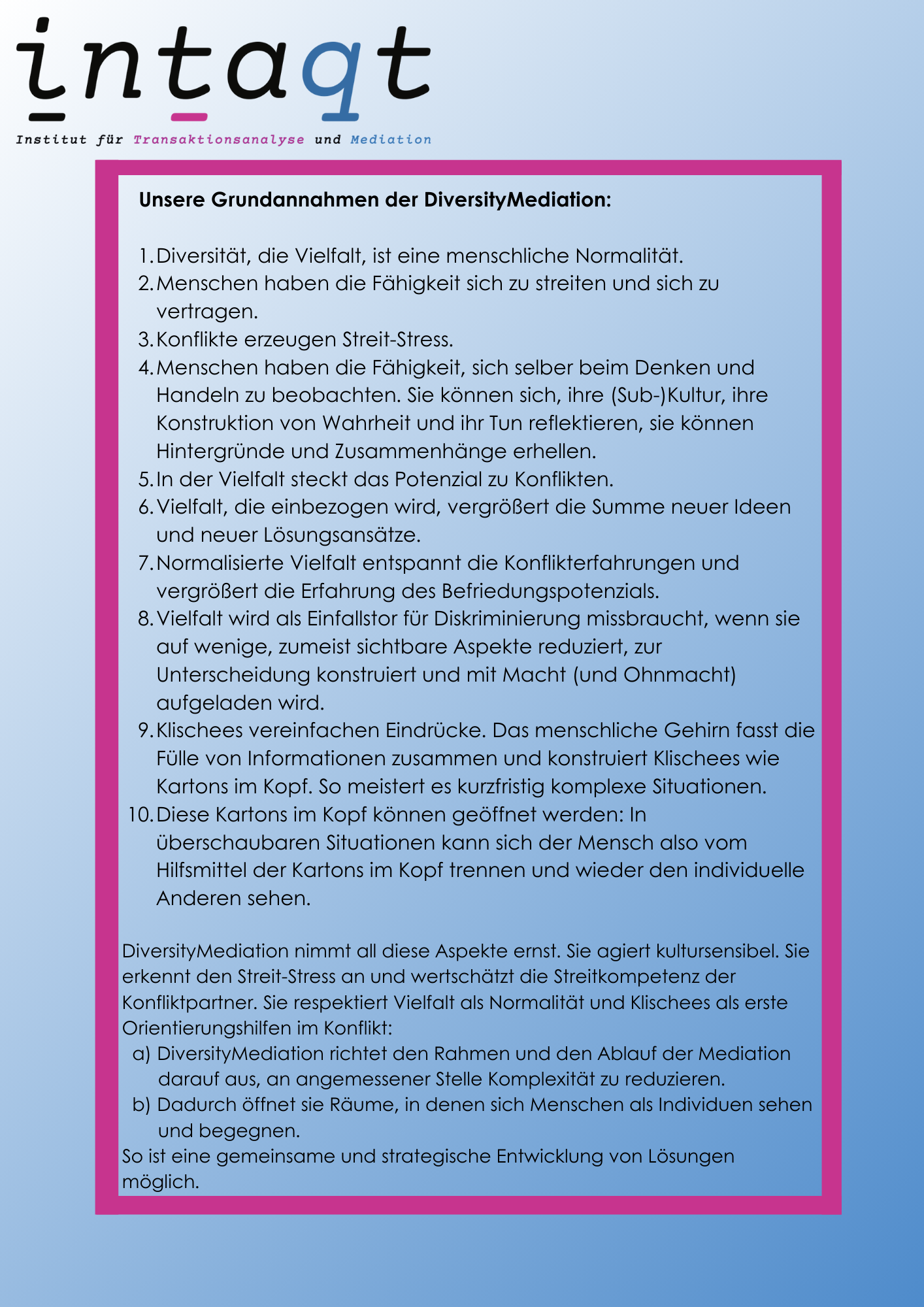
Basic assumptions of diversity mediation:
- Diversity is a human normality.
- People have the ability to argue and to get along.
- Conflicts create stress.
- People have the ability to observe themselves as they think and act. They can reflect on themselves, their (sub)culture, their construction of truth and their actions; they can shed light on backgrounds and contexts.
- Diversity harbors the potential for conflict.
- Diversity that is included increases the sum of new ideas and new approaches to solutions.
- Normalized diversity eases the experience of conflict and increases the experience of the potential for pacification.
- Diversity is misused as a gateway to discrimination when it is reduced to a few, mostly visible aspects, constructed to differentiate and charged with power (and powerlessness).
- Clichés simplify impressions. The human brain summarizes the wealth of information and constructs clichés like boxes in its head. This is how it masters complex situations in the short term.
- These boxes in the head can be opened: In manageable situations, people can separate themselves from the aid of the boxes in their heads and see the individual other again.
Diversity mediation is culturally sensitive
Diversity mediation takes all these aspects seriously. It is culturally sensitive. It recognizes the stress of the conflict and values the conflict partners’ ability to resolve disputes. It respects diversity as normality and clichés as the first point of reference in a conflict:
- DiversityMediation aligns the framework and process of mediation to reduce complexity where appropriate.
- This opens up spaces in which people see and encounter each other as individuals.
This enables the joint and strategic development of solutions.
Diversity mediation in practice
Mr. Meyer and Ms. Maier are arguing. My superiors call me into a situation in which a whole package of accusations and assumptions are already flying back and forth:
- He or she has no idea about the subject,
- and also reacts inappropriately in situations.
- He or she treats the team and colleagues completely wrong.
- She or he has nothing to say to me.
Dispute stress
We start the diversity mediation. Both of them soon escalate to the statements “typically male” and “typically female”. Both are firmly convinced that they cannot work together because the other person cannot get out of their role as “the man” and “the woman”.
I ask – what exactly is typical of “man” or “woman”, and get the following answers:
Mr. Meyer is a narrow-minded “salesman” who believes he has to subject everything to figures. A typical businessman and business administrator, according to Ms. Maier. So short on time and the only one of his kind, wants to influence everything and have his fingers in every pie. He doesn’t understand what it’s all about.
Ms. Maier is a crybaby, she can’t stay on the factual level, counters Mr. Meyer. As a social scientist, she makes blah blah blah, she doesn’t give the paragraph a second thought, she’s been at it so long that she’s settled in and no longer understands what’s needed out there.
In the course of diversity mediation, we come to the point where we separate the positions of the two from their interests – and both claim to want what is best for the organization.
From the perspective of what is required, Ms. Maier can describe that a salesperson was brought into the organization to think and push sales.
And it is from this perspective that Mr. Meyer recognizes that the social scientist produces the products that need to be distributed.
The AHA effect with the values and development square
We achieve the emotional breakthrough with Schulz von Thun’s values and development square: this helps both parties to remember the potential in the characteristics of their counterpart.
Ms. Maier and Mr. Meyer relax and can once again see, understand and grasp that sales and social science have different goals for good reasons. It is logical that they speak different languages and follow different working rhythms.
Now the diversity aspects of men and women have been replaced by completely different ones: training, length of service, function in the company, job description.
What’s more. Both realize that the team diversified when it appointed and received a “salesperson”. They understand that this diversification has affected their work, the team and the way they work together in unexpected places and at inappropriate times.
At this point, Mr. Meyer and Ms. Maier are ready to consider how they can integrate their different qualities into their everyday work in a practical, energy-saving and beneficial way in the future, for the benefit of the company, the team and themselves.
So it really is about diversity, but in completely different areas than the two had perceived in their dispute.
Learning diversity mediation
Katharina Stahlenbrecher
After I was appointed managing director of the philippinenbüro I have been supporting companies, teams and individuals since 2001, helping them to gain clarity and an overview.
In-depth studies in Managing Gender & Diversity and Mediation have sharpened my ability to be neutral yet involved, impartial yet positioned. The sentences ‘People usually have a good reason for what they do‘ and ‘Weare all different, that’s normal‘ express this. I mediate, coach and moderate with these two convictions.
I visibly transfer my experience as a managing director and from supporting change processes into the training series on diversity mediation and impactful leadership. You will gain parallel insights into the content, experience and process levels of the topics. This will allow you to frame your situations appropriately, formally and on a relational level .
In my training courses, I wholeheartedly share the joy of transformation. I am convinced that each of us is diverse and should be autonomous and equal. This work makes me happy.
Education:
Graduate theologian, degree in Managing Gender & Diversity, cert. Mediator (MM), Supervisor (DGfP)
Commitment:
Voluntary prevention officer of the Protestant Hoffnungskirchengemeinde Pankow
Spokeswoman for the Diversity Working Group at the Mediation Center Berlin